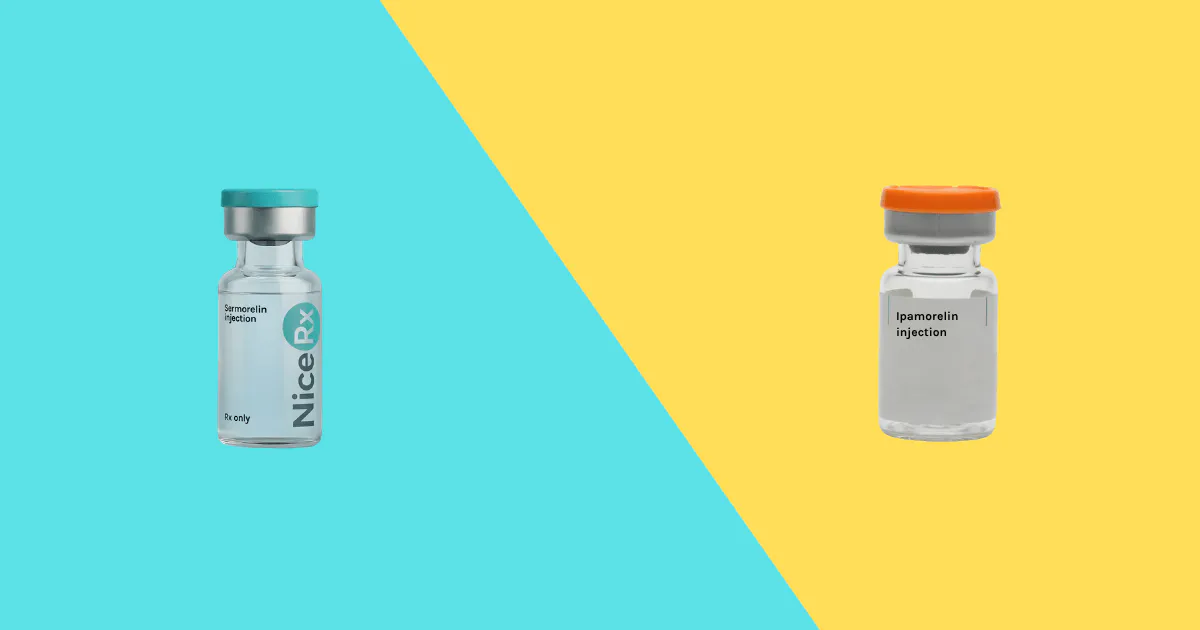
Sermorelin vs Ipamorelin: Which peptide is right for you?
Sermorelin tells your pituitary to release growth hormone. Ipamorelin removes the signal that stops it. Understanding that one difference is the key to knowing which peptide belongs in your protocol.
Key highlights
- Sermorelin and Ipamorelin are both growth hormone secretagogues, but they work differently. Sermorelin stimulates natural hormone signaling, while Ipamorelin enhances and amplifies growth hormone release.
- Sermorelin was FDA-approved as Geref in 1990 for pediatric growth hormone deficiency and was voluntarily discontinued by the manufacturer in 2008 for commercial reasons, not safety reasons. It is currently not FDA-approved for any indication but is available through licensed 503A compounding pharmacies with a valid prescription.
- Currently, Sermorelin is not an FDA-approved medication for any indication in adults or children, but can be obtained through US-licensed compounding pharmacies with a prescription.
- Sermorelin is good for improving sleep, long-term hormone balance, and a more natural approach, whereas Ipamorelin is more effective for fat loss, muscle recovery, and stronger HGH pulses.
- Both peptides are administered through small subcutaneous injections and are administered on an empty stomach. Sermorelin is typically used at night, and Ipamorelin offers more flexible timing.
- Combining Sermorelin and Ipamorelin can create a synergistic effect, but this approach should only be used when prescribed by a qualified healthcare provider.
- Sermorelin is generally less expensive ($150–$500/month) than Ipamorelin ($200–$800/month). Both medications require a valid prescription and are dispensed through licensed U.S. compounding pharmacies.
- These therapies require a prescription and medical guidance. Blood work and monitoring may also be required to ensure safety and effectiveness.
The decline in growth hormone production after the age of 30 is a natural part of aging. This natural shift in hormones can cause fatigue, weight gain, and slower recovery from workouts or injuries. Many people are now looking for ways to counteract this decline to maintain peak performance and vitality. Peptide therapy has emerged as a safer alternative to synthetic HGH because it helps stimulate the body’s natural hormone production rather than replacing it directly, which is generally considered safer and may come with fewer risks. Among the most discussed options are Sermorelin and Ipamorelin, two peptides designed to support growth hormone production through different mechanisms of action.
Growth hormone secretagogues are substances that stimulate your body to produce its own growth hormone rather than replace it, unlike synthetic growth hormone. These hormones stimulate the anterior pituitary gland, which releases growth hormone into your bloodstream. Sermorelin and Ipamorelin are growth hormone secretagogues that are administered as small subcutaneous injections (under the skin) to target the pituitary gland.
The “Sermorelin vs. Ipamorelin” debate is important in modern wellness because people want smarter and safer ways to support long-term health instead of relying on quick fixes. While both peptides aim to increase growth hormone levels, they work differently and may suit different health and performance goals. In this guide, we’ll explain how each peptide works, compare their benefits and potential side effects, and help you determine which option may be the better fit for your needs.
What is Sermorelin?
Sermorelin is a 29-amino acid peptide analog of GHRH (growth hormone-releasing hormone). Normally, the hypothalamus in your brain releases GHRH to tell the pituitary gland to release growth hormone. Sermorelin works in the same way. Once injected, Sermorelin travels to the anterior pituitary gland and activates it. This stimulation causes the pituitary to increase growth hormone secretion into your bloodstream in a natural pulse. The potential benefits of Sermorelin include the following.
- Works with the body’s natural hormone rhythm
- Improves sleep quality (since HGH is released during deep sleep).
- Increases lean muscle mass
- Improves skin thickness and elasticity by increasing collagen synthesis
- Boost energy levels
- Promote muscle growth and tissue repair
- Improve cardiovascular health
- Provides hormonal support
- Improves bone density
Sermorelin was formerly FDA-approved as Geref for treating children with GH deficiency. The medication was discontinued in 2008 for commercial reasons and is now available off-label only through licensed US compounding pharmacies with a prescription. Currently, Sermorelin is not FDA-approved for any indication in adults or children.
Sermorelin has a short half-life of 10-20 minutes. It doesn’t stay in your body very long and may require consistent dosing. Sermorelin can cause a temporary rise in cortisol levels, though this effect is still debated.
What is Ipamorelin?
Ipamorelin is a GHRP (Growth Hormone Releasing Peptide) and ghrelin mimetic which consists of 5 amino acids (Aib-His-D-2-Nal-D-Phe-Lys-NH2). It is a growth hormone-releasing peptide and ghrelin mimetic.
Ipamorelin does not copy the brain’s signal like Sermorelin. It works in the stomach and the pituitary gland to block somatostatin (the hormone that stops HGH release) and amplifies the pulse.
Ipamorelin is called the gentlest peptide because it is highly selective in nature. It targets specific receptors in the body (growth hormone secretagogue receptors) that help increase HGH levels in your body without affecting other systems.
It mimics the activity of a natural hormone called ghrelin (the “hunger hormone”). Ipamorelin binds to ghrelin receptors in the brain, signaling the body to increase growth hormone release without significantly affecting other hormones such as cortisol or prolactin, unlike older GHRPs. The key benefits of this hormone include the following:
- Highly selective in nature and has fewer side effects as compared to other GHRPs.
- It promotes a potent release of HGH, leading to strong and sharp hormone pulses.
- It supports fat loss by enhancing fat oxidation, preserving lean muscle mass, and speeding up recovery due to its rapid action.
Both sermorelin and ipamorelin are fully synthetic peptides produced in laboratory settings. Sermorelin‘s advantage is that it more closely mimics the brain’s natural GHRH signaling pathway, while Ipamorelin acts through a separate ghrelin-mimicking mechanism.
Sermorelin vs. Ipamorelin: Head-to-head comparison
Sermorelin and Ipamorelin are both peptides that stimulate growth hormone release, but they work through different mechanisms.
Sermorelin is a synthetic form of growth hormone-releasing hormone (GHRH), which directly mimics the body’s natural GHRH pathway to trigger pituitary GH secretion.
Ipamorelin is a selective growth hormone secretagogue that acts on the ghrelin receptor (GHSR-1a).
Both peptides increase GH levels, but Ipamorelin is considered more selective and does not significantly affect other hormones such as cortisol and prolactin.
| Peptide | Mechanism | Potency | Appetite Impact | Primary Goal |
|---|---|---|---|---|
| Sermorelin | Signals the pituitary to release HGH naturally | Moderate | Usually no appetite increase | Sleep, hormone balance, natural support |
| Ipamorelin | Amplifies HGH release through ghrelin receptors | Stronger | Mild hunger possible | Fat loss, recovery, muscle preservation |
Mechanism of action
The main difference between these two hormones is their mechanism of action. Sermorelin is a synthetic version of GHRH (Growth Hormone Releasing Hormone) that stimulates your anterior pituitary gland to increase the production of growth hormone in a normal and pulsatile way.
In contrast, Ipamorelin is a pentapeptide (Aib-His-D-2-Nal-D-Phe-Lys-NH2). It works by mimicking the action of ghrelin and binding to the growth hormone secretagogue receptor (GHSR) in the brain, which triggers the pituitary gland to release GH. This leads to increased levels of GH in the bloodstream, which can influence various biological processes in your body.
While GHSR is primarily active in the brain, it is also found in other tissues such as the gastrointestinal tract, heart, lungs, liver, kidneys, pancreas, fat tissue, and immune cells. Unlike many other GH-releasing peptides, Ipamorelin stimulates GH release in a more selective and controlled way.
Half-life and dosing frequency
Sermorelin has a shorter half-life (10-20 minutes), which means it acts quickly and clears the body fast. The medication is taken once daily before bedtime to align with the body’s natural HGH release during deep sleep.
Ipamorelin has a slightly longer half-life (1.5-2.5 hours). Its effects last longer than Sermorelin. However, it is still used daily but offers more flexibility in timing.
Appetite stimulation
Sermorelin generally does not stimulate appetite because it works through your brain’s natural signaling pathway and does not interact with hunger hormones.
Ipamorelin is often called the “cleanest” GHRP because it targets growth hormone release without strongly affecting other hormones. However, since it mimics ghrelin (the hunger hormone), some users may notice a slight increase in appetite when they first start using it. This effect is usually mild and temporary, and much less pronounced compared to older peptides like GHRP-2 or GHRP-6, which are known to significantly increase hunger.
Side effect profile
The most common side effect of Sermorelin is “the flush,” in which you may experience a warm or tingling sensation, sometimes with slight redness at the injection site. This happens due to temporary dilatation of blood vessels and usually fades quickly. Some people may also feel mild dizziness right after the injection. In rare cases, Sermorelin may cause a temporary increase in cortisol, but this is still debated and not consistently seen.
Ipamorelin is generally well-tolerated, but its dose matters. If the dose is too high, some users report lethargy or fatigue, likely due to hormonal shifts because it interacts with the ghrelin pathway and can increase appetite, especially when starting the medication. However, injection site reactions such as redness or irritation may also occur.
Impact on other hormones
One important difference between Sermorelin and Ipamorelin is how they affect other hormones, especially cortisol (the stress hormone). Sermorelin works through the brain’s natural signaling pathway (GHRH), but it can sometimes indirectly influence other hormones, including a temporary rise in cortisol in some users. This effect is usually mild and not consistent, but it can matter if you are sensitive to stress hormones.
In contrast, Ipamorelin is highly selective. It mainly targets growth hormone release without significantly affecting cortisol or prolactin levels. This is why it is often preferred for people who want to avoid stress-related side effects like anxiety, fatigue, or sleep disruption.
Which is better for different goals?
The choice of medication depends on your goals. Sermorelin may be best for you if your goal is better sleep, natural hormone support, and long-term balance. Ipamorelin may be a better option for you if your goal is fat loss, muscle recovery, or a stronger growth hormone pulse.
| Goal | Better Option | Practical benefits | Limitations |
|---|---|---|---|
| Sleep | Sermorelin | Aligns with natural nighttime GH rhythm, best for users preferring bedtime dosing, stable routine | Requires consistent nighttime administration |
| Fat loss | Ipamorelin | Stronger GH pulses may support fat metabolism, flexible timing for active users | May increase appetite in some users |
| Muscle recovery | Ipamorelin | Faster GH pulse response may support recovery, suited for active users with variable training schedules | Effects vary by dose and intensity |
| Natural approach | Sermorelin | Mimics GHRH signaling, supports physiological hormone release, preferred for gentler “natural cycle” approach | Slower perceived effects vs secretagogues |
| Flexibility / lifestyle | Ipamorelin | Highly adaptable timing for irregular schedules or training routines | Possible appetite increase or mild stimulation |
| Budget sensitivity | Sermorelin | Simpler single-agent protocols, predictable dosing, lower complexity | May feel less responsive than combinations |
| Cortisol sensitivity | Sermorelin | Generally more stable and less stimulating, better suited for users sensitive to stress responses or hormonal fluctuations | Less rapid GH pulse effect compared to Ipamorelin |
Can you take Sermorelin and Ipamorelin together?
Yes, you can take Sermorelin and Ipamorelin together, and in some cases, they actually work better as a combination because both medications work differently.
- Sermorelin (GHRH) sends the signal from the brain to release growth hormone.
- Ipamorelin (GHRP) removes the block (somatostatin) and amplifies the release.
When you combine them, you may get a synergistic effect. Sermorelin tells your body to release HGH, and Ipamorelin enhances that signal and prevents it from being shut down. Think of them as an amplifier; one starts the process, the other boosts it.
This concept is similar to the popular CJC-1295 + Ipamorelin stack, commonly used off-label, where a GHRH and GHRP are paired for stronger and more consistent growth hormone pulses.
A more effective strategy may involve pairing Tesamorelin with complementary options like Ipamorelin (GHRP) for synergistic growth hormone release, or Semaglutide to support appetite control and enhance overall fat loss results.
This combination should only be used when prescribed by a qualified healthcare provider and requires careful dosing and monitoring.
What to expect: Timeline of results
Sermorelin or Ipamorelin doesn’t work overnight. You may experience different changes over time as your hormone levels gradually improve.
- Weeks 1-2: You may experience better sleep quality, often with deeper sleep and more vivid dreams. This happens because growth hormone is closely linked to your sleep cycle.
- Weeks 4-8: In this phase, you may start feeling more energy, improved mental clarity, and faster recovery after workouts. This is where the effects begin to feel more noticeable in daily life.
- Months 3-6: During this phase, you may notice visible changes in your body composition, such as fat loss, improved muscle tone, and better skin texture and elasticity.
- Months 6+: With consistent use, you reach more peak results, including improvements in body composition, skin health, hair quality, and overall vitality.
Administration, dosage, and storage
Always use these medications according to your doctor’s prescription and follow the proper instructions for administration, dosage, and storage for safety and efficacy.
Administration
Both Sermorelin and Ipamorelin are administered subcutaneously (under the skin) most commonly in the belly fat area (often called the belly shot). The needles used for administration are insulin style, which are very small and thin. Most people find them painless as compared to traditional injections.
In addition, you should take these medications on an empty stomach because eating carbohydrates may spike the insulin levels, which may block or reduce the release of human growth hormone (HGH) in your body and affect the dose efficacy.
Sermorelin should be administered at night before bed because it aligns with your body’s natural growth hormone release during deep sleep. While Ipamorelin can be taken at night or after a workout, depending on your goal.
Dosage
Sermorelin dosage
| Sermorelin | Dose |
|---|---|
| General Wellness / Anti-Aging | 100-200 mcg daily |
| Starting Dose (Typical U.S. Clinics) | 200-300 mcg per day |
| Maintenance Dose (Sweet Spot) | 300-500 mcg per day |
| Medical Weight Loss | 300-1,000 mcg (1 mg) daily |
| Athletic Performance / Recovery | 200-500 mcg daily |
Ipamorelin dosage
| Ipamorelin | Dosage |
|---|---|
| General Range | 20-300 µg per day |
| Beginner | 100-150 µg per day |
| Standard | 200-300 µg (Split into 2 doses (morning and evening) |
| Advanced | Up to 400 µg (Divided into AM/PM injections) |
Storage
These peptides usually come in powder form and must be mixed with bacteriostatic water with the help of a large mixing syringe against the glass wall of the peptide vial before use. This water should be mixed well until all of the powder is dissolved. This process is called reconstitution and should be done carefully to maintain sterility.
After mixing, these peptides must be kept in a refrigerator and away from heat, light, and moisture to keep them stable and effective. They can be stored for up to 28 days.
Discard the medication if it becomes cloudy or contains particles.
Side effects, safety, and medical supervision
These peptides are only available with a prescription. They should only be used when prescribed by a qualified healthcare professional provider.
It may be required to get baseline blood work (such as HGH, IGF-1, and other hormones) before starting the mediation. This helps your doctor determine if you actually need therapy and allows for proper monitoring over time.
Sermorelin and Ipamorelin are generally not recommended for individuals with active or prior malignancy because they can increase growth hormone and IGF-1 levels, which may influence tumor growth.
These medications are contraindicated in patients with a history of active cancer, pregnancy, and breastfeeding. These medications should also be used cautiously in individuals with certain medical conditions, such as epilepsy, untreated hypothyroidism, obesity, hyperglycemia, or elevated levels of plasma fatty acids, as these conditions may increase the risk of adverse effects or alter the drug’s response.
Competitive athletes subject to WADA anti-doping rules should avoid both peptides, as growth hormone secretagogues are included on the prohibited substances list.
Discuss your medical conditions with your healthcare provider to ensure safety and improve overall health and well-being.
FAQs
Is Sermorelin or Ipamorelin better for weight loss?
If your main goal is weight loss, Ipamorelin is generally the better option because it creates a stronger and more targeted release of growth hormone that helps burn body fat and preserves lean body mass. In contrast, Sermorelin works more gradually by supporting your body’s natural hormone rhythm, making it better for long-term balance, improved sleep, and steady fat loss over time.
Do I need a prescription for peptides in the USA?
Yes, you need a prescription from a licensed healthcare provider to legally use peptides in the United States. Compounded medications like Sermorelin are dispensed by licensed compounding pharmacies. Ipamorelin and Sermorelin are not FDA-approved as a finished drug product, but may be prescribed and compounded through licensed 503A compounding pharmacies with a valid prescription.
According to the FDA’s 2023 guidance, Ipamorelin is currently not eligible for compounding under Section 503A and is classified as a Category B bulk drug substance due to a lack of safety data.
The legal pathway is through a licensed 503A compounding pharmacy with a valid prescription from a healthcare provider. That process is regulated and legal. The grey market refers to vendors that sell peptides online without a prescription. These products are not approved for human use and operate outside the legal compounding system.
Can I take these with TRT (Testosterone Replacement Therapy)?
Yes, you can use Sermorelin and Ipamorelin alongside TRT (Testosterone Replacement Therapy), but only when a licensed healthcare provider prescribes the medications to be used together.
These peptides work on the growth hormone system, while testosterone hormone replacement therapy works on testosterone levels, so they target different hormones and can complement each other. Some people may combine them to support overall benefits like improved body composition, better recovery, and increased energy.
Remember, combining therapies can affect multiple hormone pathways. Therefore, proper dosing, regular monitoring, and laboratory tests are important to avoid imbalances or side effects.
What are the long-term risks?
The long-term risks of peptides like Sermorelin and Ipamorelin are not fully known. They are generally well tolerated and considered safer than synthetic HGH. Potential risks include hormone imbalances, effects on blood sugar levels, and increased IGF-1 (insulin-like growth factor) levels, which may lead to other risks over time. Mild issues like water retention or joint discomfort can also occur. However, medical supervision and regular monitoring are important due to the limited availability of long-term safety data.
Does Ipamorelin make you hungry?
No, Ipamorelin is very selective and has minimal effect on ghrelin (hunger hormone), unlike other peptide growth hormones. It stimulates growth hormone without significantly increasing your appetite.
What is the difference between Ipamorelin and CJC-1295?
CJC-1295 is a growth hormone–releasing hormone (GHRH) analog similar to Sermorelin, but its DAC (drug affinity complex) modification gives it a much longer half-life that lasts for days instead of minutes. This extended duration is the reason it is sometimes preferred over Sermorelin as the GHRH component in peptide protocols. Ipamorelin is a growth hormone secretagogue that is commonly paired with either CJC-1295 or Sermorelin to support growth hormone release. However, this combination should only be used when prescribed by an authorized healthcare provider.
How much does Sermorelin vs. Ipamorelin cost?
The cost of Sermorelin and Ipamorelin varies depending on your location, the dosage, and the clinic or pharmacy where you purchase the medication from. Sermorelin is typically cheaper than Ipamorelin and usually costs $150-$500 per month through reputable telehealth providers. Ipamorelin costs $200-$800 per month, on average.
Conclusion: Which peptide is right for you?
When choosing between Sermorelin and Ipamorelin, the best option depends on your individual goals, blood work, tolerance, and desired outcomes, whether that includes better sleep, fat loss, recovery, or long-term hormonal balance. Both peptides support growth hormone production through different mechanisms, which is why there is no single “best” choice for everyone.
You should consult a qualified hormone specialist or functional medicine doctor before starting therapy. They will evaluate your baseline levels, prescribe the right dosage with a personalized treatment plan, and monitor your progress to ensure the treatment is safe and effective. Avoid self-prescribing, as it can lead to poor results or unnecessary risks.